

Author Archives: admin
Cameron’s article on strained Si and Ge published in J. App. Phys
 As dimensions of nanoelectronic devices become smaller, CPU hot spots become increasingly more difficult to manage. Applying mechanical strain in nanostructures provides an additional tuning mechanism for both electronic band structures and phonon dispersions that is independent of other methods such as alloying and dimensional confinement. By breaking crystal symmetry, strain increases anisotropy.
We present thermal conductivity calculations, performed in thin Si and Ge strained films, using first principles calculations of vibrational frequencies under biaxial strain, along with a phonon Boltzmann transport equation within the relaxation time approximation. We find that, while in-plane transport is not strongly dependent on strain, the cross-plane component of the thermal conductivity tensor shows a clear strain dependence, with up to 20% increase (decrease) at 4% compressive (tensile) strain in both Si and Ge. We also uncover that strain emphasizes the anisotropy between in-plane and cross-plane thermal conductivity across several orders of magnitude in film thickness. Read the article in J. Appl. Phys. here: http://dx.doi.org/10.1063/1.4971269
Our collaboration with U. Wisconsin and U. Hamburg published in Phys. Rev. Applied
We fabricate, measure, and simulate ultrathin diamond membranes with large lateral dimensions for MALDI TOF MS of high-mass proteins. With a minimal thickness of 100 nm and cross sections of up to 400×400 μm sq., the membranes offer extreme aspect ratios. Ion detection is demonstrated in MALDI TOF analysis over a broad range from insulin to albumin. The resulting data and simulations show much enhanced resolution as compared to existing detectors, which can offer better sensitivity and overall performance in resolving protein masses.
The article is available in Physical Review Applied: https://doi.org/10.1103/PhysRevApplied.6.064031
Meenakshi’s article on superdiffusion published in PRB
The latest article on phonon superdiffusion in Si-Ge alloy nanowires has been published in Physical Review B: https://doi.org/10.1103/PhysRevB.94.174303

Nazanin’s article on Si-Ge-Sn alloys published in Phys Rev Applied
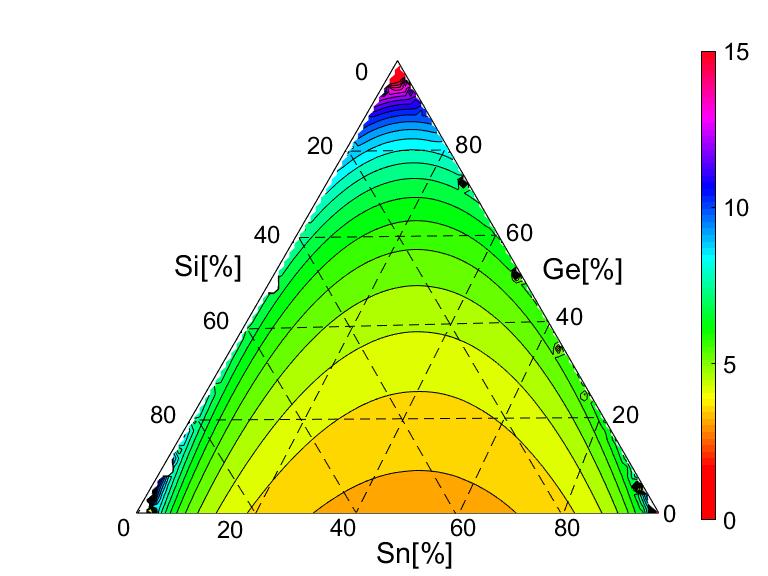 Being a good thermoelectric material is a balancing act between high electrical conductivity σ and low thermal conductivity κ, because both quantities depend directly on the flow of electrons. Fortunately, κ also depends on lattice phonons, so this contribution can be cut—for example, by scattering from randomly distributed heavy atoms. The authors’ calculations show that adding tin to alloys of silicon and germanium should yield quite good thermoelectrics, especially in thin-film systems.
Phys. Rev. Applied 6, 014015 (2016) – Published 25 July 2016
Arnab’s article on length divergence in graphene published in PRB
This article studies how thermal conductivity in graphene ribbons scales with their length and uncovers an unusual logarithmic dependence, while also explaining the eventual convergence beyond 100 um–far longer than the phonon mean free path!
http://dx.doi.org/10.1103/PhysRevB.93.235423

Prof. Aksamija selected for the Lilly Teaching Fellowship
The Lilly Fellowship is a competitive award program, established in 1986, that enables promising junior faculty to cultivate teaching excellence in a special yearlong collaboration. More information about Prof. Aksamija and other awardees here:
http://www.umass.edu/newsoffice/article/tefd-announces-2016-17-lilly-fellows
Ela Correa wins Undergraduate Rising Researcher Award
 Gabriela Calinao Correa
The Rising Researcher award is presented to Gabriela Calinao Correa, class of two-thousand-sixteen, for her dedicated pursuit of research with meaningful, tangible, and publishable results. Gabriela’s Honors Thesis led to the development of a new computational model for heat transfer between 2D van der Waals materials (such as graphene) blanketing 3D substrates used in the semiconductor industry to build nanoelectronic devices. She gave a talk on this research at the fall 2015 Materials Research Society Meeting in Boston, Massachusetts, a rare opportunity for an undergraduate researcher. Gabriela’s faculty advisor is Zlatan Aksamija, electrical and computer engineering. Congratulations, Gabriela!
More information about the award at ResearchNext: http://www.umass.edu/researchnext/researcher/passionate-pursuit
NVIDIA Academic Hardware Grant Program Awards NTSL 2 Tesla K40 GPU cards
The Nanoelectronics Theory and Simulation Lab is fortunate to have been selected as a recipient of 2 NVIDIA Tesla K40 GPU cards (adding up to a total of 5760 cores, capable of 8.6 Tflops performance!) to accelerate our calculations. This award is part of NVIDIA’s Academic Hardware Grant Program.

Our invention of folded 2-D thermoelectric elements featured on TTO’s website
This invention, co-invented with Prof. Robert Blick of the University of Hamburg, us es folded 2-dimensional materials to reach enhanced thermoelectric conversion efficiencies. 2-D materials like grapheme are great electrical and thermal conductors; by folding them, the thermal path is suppressed, diverting more thermal energy into electrical, thereby increasing thermoelectric conversion efficiency:
http://tto-umass-amherst.technologypublisher.com/tech/Efficient_Thermoelectric_Converters